 THE
LEGOBOT
THE
LEGOBOTA WALKING ROBOT MADE OF LEGO® PIECES
[BEFORE I START] [SOME OBSERVATIONS] [THE CHALLENGE] [THE MECHANICS] [THE PROJECT] [THE MACHINE] [OTHER LINKS]
My interest in biomechanics is related to ergonomics and human factors involved in the interior design process. Human gait, in particular, is of great interest, given the complex, multi-sensorial process required to balance the human body. This project is just a simple exercise in understanding this remarkable human capability.
SOME OBSERVATIONS
There are different opinions regarding the comparison between wheels and legs, or, in other words, between rolling and walking. The first moving method uses mechanical parts engaged in an one-way, non-limited movement, which is rotation, while the latter uses two-way, limited movements for its oscillating parts. Obviously, the physical limitations of biological system do not allow infinite one-way rotation, but this is far of being a drawback. For same performance, rolling systems have much more contact surface than the walking ones, and they need to stay in contact with the support surface at all times. The requirements for biomechanical systems are numerous: an animal has to be able to jump, climb, fight, walk and run on difficult terrain, to start moving quickly and to stop safely. It is interesting to notice that in millions of years of evolution, almost any animal had enough time to realize that anything is easier to roll over than to push or drag, but Nature did not think to create the wheel.
The dynamics and the controls of human gait are extremely complex. Basically, the body's mass center is not only traveling along a complex curve, but its gravity vector points out of the supporting area at all times while walking. The balance is created in a dynamic process that considers speed, accelerations, and inertia, as mechanical factors. If the body stops suddenly, like in a "freeze" frame in a video, it cannot keep its balance, because there is no static balance involved in walking. The reason behind this is that a mechanical system will spend more energy moving its body within the limits of its static balance, than using the impulse of its movement. An interesting part of the walking process is the actual start moment, because it makes the transition from static balance to the dynamic one. (In fact, even what I call here static balance is a dynamic one as well, but our subroutines give us the impression that we are still; being supported on joints, our body needs continuous control of vertical position, which implies minor modifications in muscle's tension. If you try to relax while standing up, you fall off your feet...) The moment of start is very important, because it will create the premises for the type and the speed of the following movement. At that moment, the brain calculates in advance the future path and assumes specific values for speed and acceleration. Maybe you noticed that once you started walking, if you instantly change your mind and want to run, you may find yourself in a moment of unbalance, because each kind of movement needs its own start. If you plan to go from a dead stop and walk slowly, you can almost feel how you push one leg down to break the balance and to launch the body on a lateral-forward movement; if you have to run, the body will be pushed forward and even more to the side than before.
A brief look at the factors I consider as input for controlling the gait will show the following:
- pressure: information about the distribution of the body weight through its points of support.
- acceleration: information about the variation of speed on multiple axis, but mostly in the horizontal plane.
- visual reference: the image we see is very important in balancing our body. (I just mention the classic example about the impulse to balance our body while sitting in a still train, when looking out the window at the other train that is just leaving).
A walking robot that can process this information is another project I am thinking of, but for now, let's have a look at the LEGOBOT.
THE CHALLENGE
This project intends to create a powered biped robot that is able to walk by shifting its weight from one leg to the other. The system does not have an intelligent module (does not process information).
THE MECHANICS
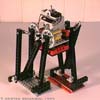
The kinematics of this legobot is based on two mechanical subsystems: one group of elements creates the longitudinal oscillating movement of the legs/feet assemblies, while another group of parts gives the transverse balancing movement for shifting the weight from one leg to the other. These two subsystems are synchronized by being actuated by a single motor, using a simple set of gears. Therefore, the robot does not need to process information about its relative position, because gravity always projects its mass center on a support area.
THE PROJECT
LEGOBOT is made of 106 pieces of LEGO® (including a miniature electric motor and its switch), plus a small 9 Volt battery, its connector, and two rubber bands on its foot plates for better grip. It is about 8 inches high, weights about 11 ounces (310 grams) and it can walk about 6 ft/min (1.80 m/min). Its walk is quite firm and stable, considering the LEGO® parts do not always create very stiff joints and pivots.
After the basic principle proved to be correct, a lot of work was required for tuning the mechanism. The height of the machine, the width, its weight, the walking speed, the movement angles of the legs and foot plates were tested for different configurations. The LEGO® structure proved to be extremely flexible, offering many possibilities for solving the problems of this project.
THE MACHINE
The following links will show how this LEGO® walking robot looks and (if you have a fast internet connection) even how it moves.
 images
 movie / 10 sec., mpg1 (3,300 KB).
movie / 60 sec., mpg1 (19,100 KB).
movie / 10 sec., mpg1 (3,300 KB).
movie / 60 sec., mpg1 (19,100 KB).
You may find more examples of LEGO® machines at Technic Puppy Journal.
Please send me your comments on this project at myoptix(at)costandesign.com
Thanks,
Costan Boiangiu



LEGO® is a trademark of the LEGO Company which does not sponsor, authorize or endorse this site.
Last edited on
December 6, 2013
Copyright
2001-2013, Costan Boiangiu. All rights reserved.

